
The landscape of computer science education across elite institutions in the United States has undergone a tectonic shift. As software ecosystems grow in structural complexity, academic programs at premier institutions—such as Carnegie Mellon University (CMU), the University of California, Berkeley, and the Massachusetts Institute of Technology (MIT)—have adjusted their academic benchmarks. Undergraduate and graduate students are no longer evaluated merely on whether their code compiles; they are judged on computational efficiency, structural architecture, scalability, and algorithmic rigor. For many students, this escalated standard transforms data structures, operating systems, and compiler design courses into high-stress academic roadblocks.
This reality is reflected in nationwide academic metrics. Empirical research indicates that computer science introductory and mid-level courses experience an average attrition rate of 25% to 30% across major institutions in the United States. The challenge stems from a widening pedagogical gap: while high school curricula often emphasize basic syntax and functional script execution, university course syllabi mandate low-level engineering proficiency, rigorous memory optimization, and strict execution-time thresholds. When structural academic pressure intersects with dense project requirements, securing professional, data-driven help with programming assignment hurdles becomes an essential strategic intervention for scholars striving to protect their GPA while mastering underlying theoretical paradigms.
To navigate these challenging academic environments successfully, one must analyze the foundational issues that make modern programming assignments so notoriously difficult. Success in a contemporary computer science degree requires shifting from simple trial-and-error coding to systemic software engineering. This transition demands rigorous project management, advanced debugging competencies, and access to authoritative instructional support systems designed to reinforce classroom education.
Strategic Key Takeaways
- Pedagogical Shock: Low-level memory management and structural constraints cause significant academic attrition in early-to-mid university computer science programs.
- The Precision Imperative: Top tier US universities grade heavily on runtime efficiency, memory leak avoidance, and complex algorithmic edge cases.
- Strategic Intervention: Utilizing expert academic resources prevents burnout, clarifies conceptual blockages, and preserves operational GPA metrics.
- Algorithmic Thinking: Shifting away from trial-and-error scripting toward comprehensive design verification is the cornerstone of academic success.
In introductory programming, students frequently interact with high-level interpreted languages such as Python or JavaScript. These environments feature automatic memory allocation, abstraction layers, and dynamic typing that mask the hardware reality underneath. However, mid-level core requirements in American institutions—often titled Introduction to Computer Systems or Systems Programming—strip away these guardrails. Suddenly, students are exposed to the raw mechanics of the CPU, cache hierarchies, and volatile registers.
The primary barrier in these advanced environments is explicit memory governance. In languages without garbage collection, a misplaced memory address or uninitialized pointer can cause sudden segmentation faults or hard-to-detect memory leaks. For instance, an assignment requiring the construction of a custom shell or a dynamic memory allocator demands total precision. A single byte offset error can corrupt the entire heap allocation space, leading to unpredictable system crashes during grading runs on automated autograders like Gradescope.
Consider the core mathematical model governing spatial allocation efficiency. The memory utilization ratio U can be formulated as follows:
U = \frac{\sum (M_{\text{payload}})}{H_{\text{size}}}
Where M_{\text{payload}} represents the memory directly allocated to student data blocks, and H_{\text{size}} represents the total structural volume of the heap space including internal fragmentation overhead. University autograders systematically calculate this fraction; if your custom allocation model yields poor utilization or experiences internal fragmentation, the submission fails the optimization threshold, regardless of functional accuracy. Navigating these highly specialized system requirements can be remarkably daunting, which is why students frequently look toward specialized resource providers to balance their heavy workloads. Access to tailored c++ assignment help allows students to break down advanced object lifetimes, safely manipulate pointers, and debug complex inheritance models without risking system stability.
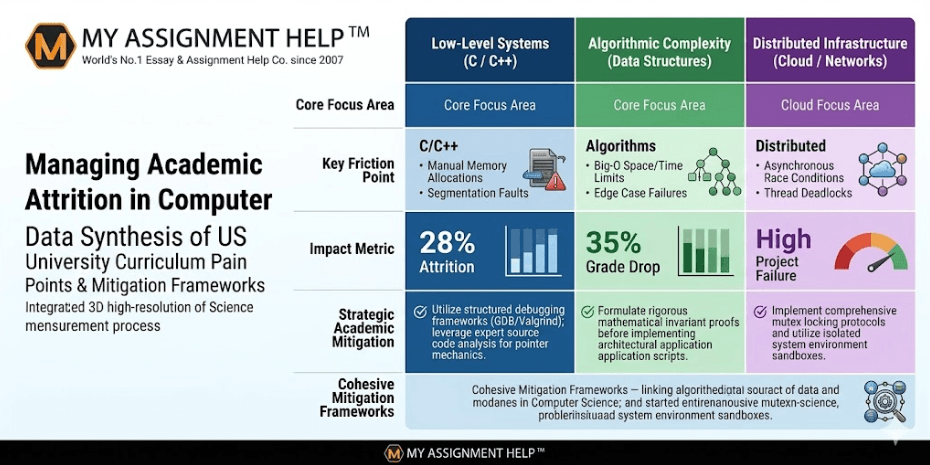
Visual Roadmap: Managing Academic Attrition in Computer Science
Data Synthesis of US University Curriculum Pain Points & Mitigation FrameworksA distinct feature of computing education in the United States is the widespread adoption of automated evaluation frameworks. While professors in alternative academic streams read written arguments and offer partial points for conceptual layout, programming autograders function on strict binary logic: either the input yields the precise expected output within explicit resource bounds, or it earns zero credit.
This automated screening introduces two distinct architectural pressures that students must manage:
1. Execution Time Constraints (Temporal Efficiency)
If an assignment requires processing a dataset of N elements, and the student’s solution runs at a suboptimal time complexity of O(N^2) instead of the optimal O(N \log N), the grading server will terminate the script process due to a timeout exception. To the autograder, an inefficient algorithm is indistinguishable from an infinite loop.
2. Hidden Test Suites and Extreme Inputs
Students regularly pass their local test configurations only to receive a low mark upon formal submission. This happens because university grading scripts run code through unannounced edge scenarios, including null input limits, oversized integer boundaries, and unexpected concurrency stresses designed to expose fragile code logic.
The code fragment below highlights a common vulnerability in dynamic string assembly where an unhedged loop structure triggers buffer overflows—a frequent point of failure under rigorous autograder evaluation:
C++
// Dangerous runtime vulnerability often exposed by university autograders
#include <iostream>
#include <cstring>
void processStudentInput(const char* rawData) {
char internalBuffer[128];
// Vulnerability: No bounds checking applied during execution
std::strcpy(internalBuffer, rawData);
std::cout << “Processed structural payload: ” << internalBuffer << std::endl;
}
int main() {
// Autograders test inputs exceeding 128 bytes to force segmentation faults
const char* maliciousInput = “An exceptionally long academic test string designed to exceed the internal destination allocation buffer…”;
processStudentInput(maliciousInput);
return 0;
}
Overcoming these hidden traps requires learning to run systematic trace routines and memory leak checks before submitting. Developing an eye for edge cases is what separates standard script writers from true software engineers.
Surviving an advanced computer science track in the United States requires tactical planning that matches the operational rhythms of your department. Below is the operational framework practiced by top tier software developers and academic honors students alike:
Adopt an Incremental Architecture Strategy
Writing an entire 1,500-line programming project in a single session before compilation is an open invitation for complex, hard-to-trace bugs. Instead, break your development down into isolated modules that can be tested independently. Build the foundational data structures first, verify their memory usage using a tool like Valgrind, and only then proceed to layer on advanced features. This incremental development strategy ensures that when an error does appear, you know it resides within the specific, small module you just introduced.
Implement Comprehensive Test-Driven Strategies
Do not rely solely on the basic test scripts provided by your course instructors. Write your own rigorous test suites that deliberately target edge conditions, such as extreme values, empty inputs, and massive data sets. By identifying and fixing performance bottlenecks locally on your machine, you can avoid frustrating point deductions from unforgiving remote evaluation autograders.
Utilize Institutional and Supplementary Educational Resources
When you encounter a persistent conceptual barrier, avoid wasting hours spinning your wheels in frustration. Attend your professor’s office hours, engage with undergraduate teaching assistants on discussion boards like EdStem, and seek out high-quality supplementary instructional support. Integrating targeted professional guidance early on can clarify complex theoretical concepts and keep your projects on track well before final deadlines arrive.
As academic tracks become faster and more demanding, independent supplementary learning platforms have become an important part of the student support ecosystem. When professors must divide their attention among lecture halls of hundreds of students, personalized educational interventions can bridge the gap between abstract theory and practical implementation.
Experienced content strategists note that these external academic platforms help reduce systemic attrition by providing clear, step-by-step structural analyses of complex topics. This targeted instruction demystifies low-level execution mechanics, helping students learn how to read error logs and write maintainable, efficient code. When utilized as an educational resource, structured academic support empowers students to overcome difficult programming bottlenecks, build foundational technical skills, and succeed in a demanding professional field.
See also: Professional Digital Platform 634188628 Hub
Frequently Asked Questions (FAQ)
1. Why do American university computer science courses experience high attrition rates?
The drop-out and switch rates stem primarily from the dramatic shift from basic syntax training to advanced architectural engineering. Many students enter university unprepared for low-level machine management, hardware-level memory optimization, and the strict time complexities required by elite institutions.
2. How can I identify hidden memory leaks before submitting code to an automated grading system?
You should integrate debugging toolsets like Valgrind or Dr. Memory into your local development pipeline. Running your compilation builds through these diagnostic frameworks exposes leaked allocations and uninitialized read errors that might otherwise pass standard runtime checks but fail under strict autograder scrutiny.
3. What is the most effective approach for debugging a segmentation fault?
The most effective approach is to isolate the fault line using the GNU Debugger (GDB). Compile your source code files with the diagnostic flag enabled, execute the binary within the debugger, and use backtrace commands once the system crashes to locate the exact pointer operation causing the failure.
4. How do high-level educational platforms support students facing complex coding challenges?
These platforms bridge the instructional gap by providing customized, step-by-step code analysis and conceptual breakdowns. They offer practical examples of complex topics like memory alignment or database isolation levels, helping students understand how abstract theory applies to real-world code.
About The Author
Senior Academic Consultant & STEM Strategist | MyAssignmentHelp
The author is an experienced software engineer and educational writer specializing in computer science curricula across the United States. Having spent over a decade working within higher education environments and supporting engineering candidates at MyAssignmentHelp, they specialize in breaking down advanced programming paradigms, systems architectures, and compilation mechanics into clear, accessible learning paths.
References & Empirical Sources
- National Center for Education Statistics (NCES). (2024). Stem Discipline Enrollment Trends and Attrition Realities across Tier-1 US Public Universities. US Department of Education.
- Carnegie Mellon University, School of Computer Science. (2025). Pedagogical Documentation on Introduction to Computer Systems and Automated Grading Architectures. CMU Academic Press.
- Association for Computing Machinery (ACM). (2024). Annual Survey of Undergraduate Computer Science Enrollments, Grading Biases, and Retention Frameworks. ACM Digital Library.


